


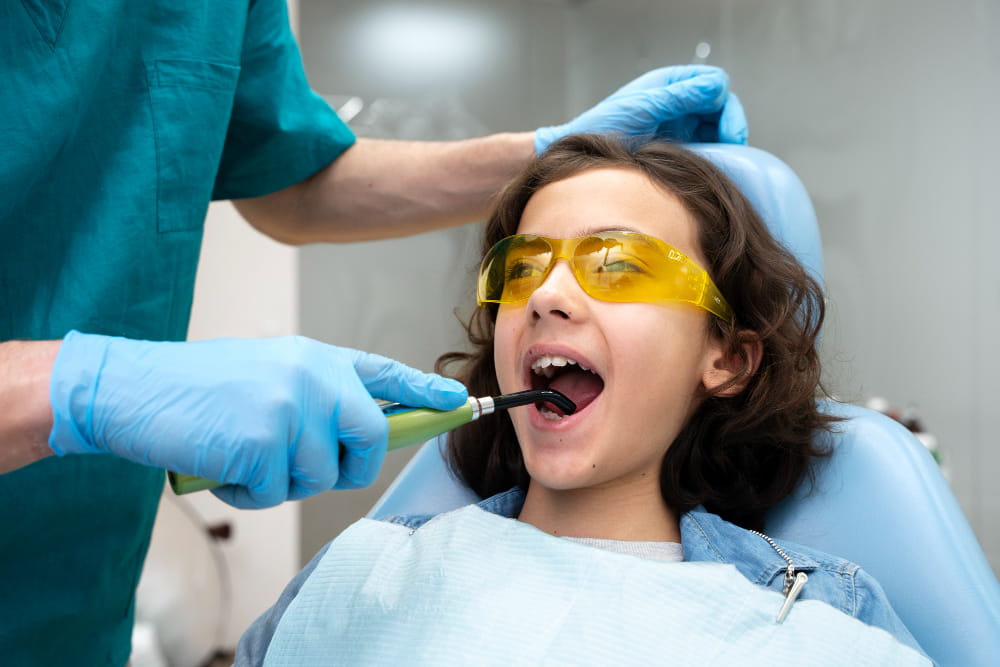
Baby Tooth Treatment
Primary tooth treatment is the general term for preventive and therapeutic procedures applied to children to prevent the risks of decay, infection, fractures, sensitivity, and early tooth loss during the temporary dentition period. Families sometimes relegate primary teeth to a secondary priority, thinking “they will change anyway.” However, primary teeth are not just temporary structures. They play vital roles in a child’s nutrition, speech development, jaw growth, aesthetic appearance, and maintaining space for the permanent teeth that will follow. Therefore, delaying a problem in a primary tooth often means turning a small issue into a larger one.
Primary teeth usually begin to appear in the mouth from the 6th month, and the primary dentition of 20 teeth is completed around the age of 2.5 to 3 years. These teeth begin to be replaced by permanent teeth starting around age 6. However, not all primary teeth change in a short time. Especially the primary molars in the back can remain in the mouth until ages 10-12. In other words, whether a primary tooth is “about to fall out soon” depends on the child’s age and the type of tooth. It is incorrect to postpone treatment without making this distinction.
Primary tooth treatment is not limited to just filling cavities. It encompasses many procedures such as preventive fluoride applications, fissure sealants, fillings, pulpotomy (amputation) treatment, root canal treatment, crowns, space maintainer planning, and extractions when necessary. The choice of treatment is determined by the depth of the decay, the status of infection, the duration the tooth needs to stay in the mouth, and the child’s overall oral health. Our primary goal is to keep the tooth healthy in the mouth as much as possible. Early loss of primary teeth can lead to the shifting of neighboring teeth and future orthodontic problems.
A painful primary tooth affects a child’s daily life more than we might think. The child stops chewing on that side, sleep patterns are disrupted, appetite decreases, attention wanders during lessons, and sometimes restlessness is misinterpreted as a behavioral problem. However, there is a silent, progressing toothache underneath. Therefore, primary tooth treatment is not just an effort to save a tooth; it is an approach to protecting the child’s quality of life.
What is Primary Tooth Treatment?
Primary tooth treatment covers all preventive and restorative procedures applied to control decay, trauma, infection, sensitivity, and tissue loss in children’s temporary teeth. These treatments are not only performed to resolve the current problem but are also planned to prevent pain, maintain chewing function, preserve space for permanent teeth, and ensure the healthy continuation of the child’s oral development. In other words, primary tooth treatment is the cornerstone of pediatric oral health.
Primary teeth have thinner enamel and dentin layers compared to adult teeth. This is why cavities can progress more rapidly. A surface cavity that appears small can quickly approach the nerve and cause the child to experience pain. Especially in cases of early childhood caries, front teeth and back primary molars can be seriously affected. In such cases, more comprehensive solutions like pulp treatments, crowns, or space maintainer planning may be required.
The scope of primary tooth treatment includes:
- Fluoride applications
- Fissure sealants
- Caries removal and fillings
- Pulpotomy (Amputation) treatment
- Primary tooth root canal treatment
- Crown applications
- Tooth extraction
- Space maintainer planning
- Post-traumatic follow-up and repair
The answer to why primary teeth are so important is clear: they help the child learn to speak correctly, chew food efficiently, feel aesthetically comfortable, and act as guides for the permanent teeth that will follow. If space loss occurs due to early extractions, the need for future orthodontic treatment increases.
How is Primary Tooth Treatment Applied?
Primary tooth treatment is applied with a plan that varies according to the child’s clinical needs. The first step is always a detailed examination. Whether there is decay, how far it has progressed, signs of infection, the condition of the gums, and how much longer the tooth should stay in the mouth are all evaluated. X-rays are very valuable in this planning, as interproximal (between teeth) cavities and proximity to the pulp cannot always be fully understood by external inspection.
The application of primary tooth treatment can be categorized as follows:
- Preventive treatment: Fluoride and fissure sealants
- Restorative treatment: Caries removal and fillings
- Pulp treatment: Pulpotomy or root canal treatment
- Full-coverage restoration: Crowns
- Surgical approach: Extraction
- Follow-up treatment: Space maintainers and control plans
During the application, local anesthesia is a frequently used method to ensure the child is comfortable. In pediatric dentistry, behavior management is as much a part of the treatment as the technical procedure. Age-appropriate explanations are provided to maintain a sense of trust. The treatment may be completed in a single session or may require several appointments depending on the child’s cooperation and the number of procedures.
Who is Eligible for Primary Tooth Treatment?
Primary tooth treatment is suitable for all children who have decay, sensitivity, infection, trauma, structural defects, or a risk of early tooth loss in their primary teeth. In fact, any child with primary teeth in their mouth is a candidate for treatment when necessary. This includes preventive purposes like fluoride and fissure sealants applied before decay even forms.
Common situations in children eligible for primary tooth treatment include:
- Presence of decay in primary teeth
- Sensitivity to cold, hot, or chewing
- Signs of night pain or infection
- History of tooth fracture or trauma
- High risk due to a history of multiple cavities
- Risk of early loss of a primary tooth
- Situations where maintaining space for permanent teeth is vital
Regular check-ups are very valuable because primary tooth decay can sometimes progress without causing pain. Families might think “it doesn’t hurt, so it’s not important,” but a silent cavity can turn into an infected state within a few months.
Precautions Before Primary Tooth Treatment
Precautions before treatment ensure both the child’s comfort and the smooth progress of the session. First, the child’s general health status, medications, allergies, and past dental experiences should be shared with the dentist.
Key points to consider before treatment:
- Health history should be shared completely.
- Medications and allergies must be stated.
- The child should come to the clinic after a light meal (neither too hungry nor too full).
- The child should be well-rested; morning appointments are often more productive for younger children.
- Scary expressions (like “needle” or “pain”) should be avoided.
- The appointment time should be chosen when the child is most cooperative.
If the child is coming due to trauma, details such as when the event occurred, any discoloration or wobbling, and the severity of the impact should be noted. If coming for decay, the duration of pain and whether it increases at night should be shared.
Precautions After Primary Tooth Treatment
The primary goal after treatment is to support healing and ensure the child’s comfort. If local anesthesia was applied, care must be taken to ensure the child does not bite their lip, cheek, or tongue until the numbness wears off (usually 1-3 hours). Children are often curious about the numbness and may bite the area repeatedly, causing serious soft tissue wounds.
Key points to consider after treatment:
- Avoid lip and cheek biting until numbness passes.
- Avoid very hot and very hard foods in the first few hours.
- Do not stop tooth brushing; maintain gentle but regular cleaning.
- Seek a follow-up if pain, swelling, or night discomfort persists.
- Apply prescribed medications or recommendations regularly.
- Do not neglect follow-up appointments.
Success in primary tooth treatment is not measured only by the day of the procedure; it is confirmed by pain-free function, infection control, and space maintenance in the following months.
In Which Situations is Primary Tooth Treatment Used?
Primary tooth treatment is applied in any situation that disrupts or risks the health and function of primary teeth. The most common cause is decay. Because primary teeth are structurally thinner, cavities reach the nerve quickly.
Primary situations where treatment is applied:
- Initial or advanced decay
- Hot-cold sensitivity
- Night pain and pulp involvement
- Dental abscess or infection
- Fractures or displacement due to trauma
- Structural enamel defects
- Risk of early tooth loss
- Need for space maintenance for permanent teeth
The duration the tooth will stay in the mouth is also important in decision-making. A primary tooth that will fall out soon is not approached the same way as one that will serve for another 4-5 years. This evaluation must be made by a dentist.
How Long Does the Procedure Take?
The duration depends on the type of procedure, the number of teeth, and the child’s cooperation. While a simple examination and preventive application may take 10-15 minutes, fillings usually take 20-30 minutes. Pulp treatments or crowns may require 30-45 minutes or longer.
Approximate durations:
- Examination and preventive applications: 10-20 minutes.
- Simple filling: 20-30 minutes.
- Deep decay and pulp treatments: 30-45 minutes.
- Crowns or multiple tooth treatments: 40-60 minutes or more.
In some children, it is better to divide the treatment into several appointments to maintain cooperation. This is not a waste of time but a child-friendly clinical management strategy.
Prices for Primary Tooth Treatment
Prices vary based on the type of procedure, the number of teeth, the depth of decay, and the need for additional pulp therapy or crowns. It is misleading to give a single fixed fee because each procedure requires different materials, time, and clinical precision.
Primary factors affecting the price:
- Type of procedure performed
- Number of teeth
- Level of decay or infection
- Need for fillings, pulp treatment, crowns, or extractions
- Need for space maintainers
- Clinic location and standards
Early intervention is almost always more advantageous both biologically and economically. A cavity left untreated can lead to more comprehensive and costly processes like root canal therapy, extractions, or space maintainers. The most accurate pricing is provided after an examination and radiographic evaluation, ensuring a transparent and personalized treatment plan.
My Happy Patients
Patient Reviews
5 yaşındaki oğlumun diş tedavisi için çok endişeliydim ama doktorumuz sayesinde her şey beklediğimden çok daha güzel geçti. Sedasyonla hiçbir şey hissetmeden, korkmadan tedavisini oldu. Çocuğuma yaklaşımı, sakinliği ve güler yüzü bizi çok rahatlattı. Hem oğluma hem bize güven verdiğiniz için size çok teşekkür ederiz, iyi ki yollarımız kesişmiş.
M.K.
Лучший русскоязычный детский стоматолог в Анталье! Очень деликатный и профессиональный подход к маленьким деткам. После приема все дети уходят действительно довольные и очень счастливые. Огромное спасибо нашему дорогому доктору за такую добросовестную работу и искреннюю любовь к своим маленьким пациентам! 🌸🌸🌸
I.P.
Мои дети совсем не боятся ходить к стоматологу, потому что у нас есть замечательный врач Раиса. Мы точно знаем, что нам всегда будет оказана самая квалифицированная помощь. Кроме того, Раиса умеет находить подход к детям, она очень спокойная, чуткая и добрая. Мы очень любим нашего стоматолога и всегда доверяем только ей.
❤️
A.P.
Kızım 8 yaşında ve asla bir diş hekimine götüremiyorduk.
Çok korkuyordum nasıl oturtacağız o koltuğa?!
Raisa hanımın yaklaşımı ve kızımla uyum sağlamasına inanamadım. Asla huysuzluk yapmadan oturdu o koltuğa.
Çok çok teşekkürler Doktor hanım❤️Emeğiniz ilginiz alakanız için çok teşekkür ederiz
D.A.
Выражаем наше большое спасибо доктору за невероятную заботу и очень внимательное отношение к нам! Лечение зубов под седацией прошло на удивление спокойно, и наш ребёнок совсем не боялся процесса. Мы очень сильно благодарны вам за ваш высокий профессионализм, доброту и чуткость. Вы настоящий мастер своего дела, который умеет найти
Д.я.
У сына разболелся зуб. Обратилась к доктору Раисе в Коньялты. После лечения захотелось написать отзыв. Ребёнку шесть лет, он очень боится врачей, но здесь страх сразу исчез. Всего были в клинике три раза, лечили каналы. Доктор всё показала и доходчиво объяснила. Она очень внимательная и чуткая. Нам повезло!
Л.Б.
Oğlumu 9 yaşında dişlerini kolay kolay bakıtmaz yaptırmaz diş hekimlerinden korkar ve özel eğitimli bir çoçuk bir kaç doktor gezdik asla bakıtmadı RAİSA HANIM tanıştıktan sonra korkularımız azaldı
diş amaliyat Raisa hanım yaptı
Başta diş hekimi Raisa hanıma sonra ekibine çok teşekkür ederim ☺️ 🙏 Tedavi olmak isteyen herkese tavise ederim
N.Y.
Это был первый визит моего ребёнка к стоматологу. Мы были на отдыхе и очень переживали, но доктор Раиса Ахмадова оказалась просто волшебником! Она спокойно объяснила процесс, шутила и вовлекла ребёнка. Всё прошло настолько легко и позитивно, что ребёнок полностью расслабился. Огромное спасибо за ваше внимательное о
I.A.
Kızımın diş tedavisi için düzenli olarak Dr. Raisa Ahmedova'ya gidiyoruz ve her seferinde inanılmaz memnun kalıyoruz. Kendisi hem çok profesyonel hem de çocuklarla inanılmaz ilgili ve sabırlı. Kızım dişçi koltuğuna oturmaktan çekiniyordu ama Raisa hanımın sıcak yaklaşımı sayesinde hiç korkmadan tedavisini tamamladı. İşini büyük bir özenle ve titizlikle yapıyor.
R.G.
Çocuk ruhuna hitap eden, muhteşem bir diş hekimi.Başka bir klinikte ağlayarak koltuğa oturduğu için hemen ameliyatli tedaviye yönlendirilen oğlum Raisa hanım sayesinde gayet sakin bir şekilde dolgusunu yaptırdı.Asistani da oğluma destek oldu, ekip olarak muhteşemler .... Birçok dişi tedavi edilmesi gereken oğlum "anne ben tekrar gelirim bu doktora " dedi.
N.Ç.
Oğlumun diş ağrısı vardı. Fotoğrafta Türkçe adı yazılı olan klinikte Dr. Raisa'ya gittim (Türkçe bilmiyorum :)). Konyaaltı bölgesinde. Tedaviden sonra bir yorum yazmak istedim. Anlarsınız, 6 yaşında bir çocuk doktorlardan korkar. Ama ilk ziyaretten sonra artık korkmuyordu. Toplamda üç kez kliniğe gittik. Dişi kurtarmak için kanal tedavisi yaptılar. Herşey için teşekkürler
H.İ
Contact Us!
We’re here to help with all your questions and requests.
-
Toros Mah. 805 Sk. Kurgu 1 Plaza No: 14/1 KONYAALTI/ANTALYA