


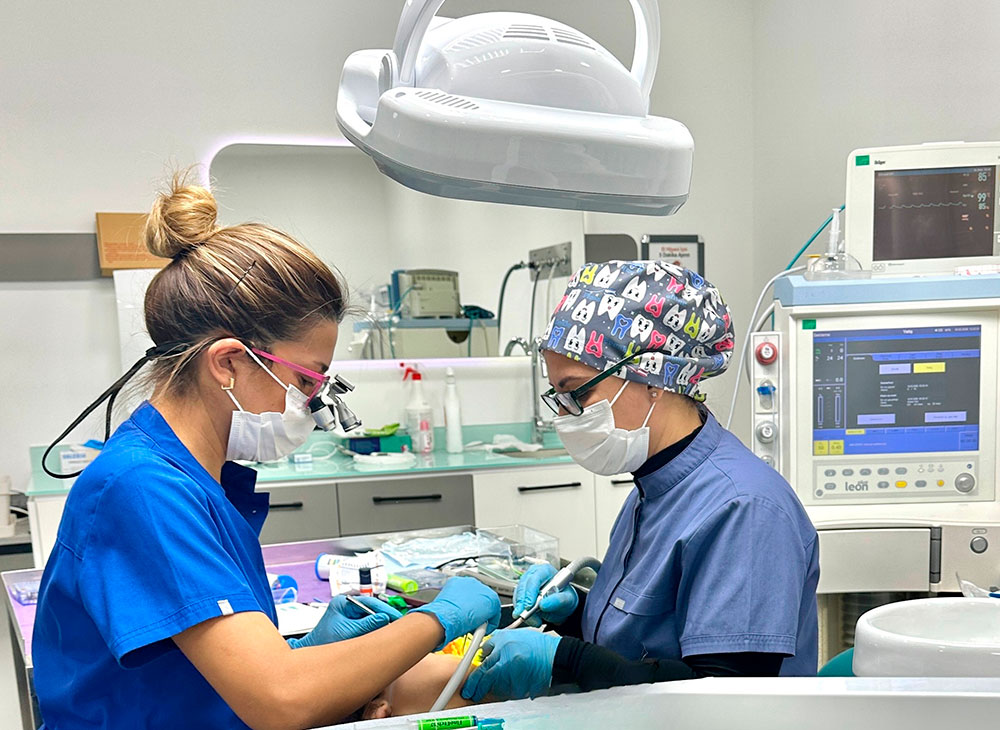
Dental Treatment Under General Anesthesia and Sedation
Dental treatment under general anesthesia and sedation represents advanced therapeutic approaches that ensure dental procedures, which are difficult to complete in conventional clinical settings for children, are performed in a controlled, safe, and planned manner. In pediatric dentistry, not every patient is expected to demonstrate the same level of cooperation in the dental chair. Some children cannot keep their mouths open for long periods due to their age, some do not permit treatment due to intense fear, and others have special health needs or require a high volume of procedures. In such cases, sedation or general anesthesia are vital options that make treatment possible.
It is necessary to distinguish between these two concepts. Sedation is a controlled alteration of the level of consciousness that allows the child to relax, reduces anxiety, and makes them more compliant with treatment. The child may not be fully asleep; depending on the depth of sedation, they may be calm, drowsy, or in a state with limited response to environmental stimuli. In general anesthesia, the child is completely put to sleep, and the treatment is performed while all vital signs are continuously monitored by an anesthesia team. The decision on which is appropriate is made based on the child’s age, health status, scope of treatment, and behavioral level.
The greatest concern for families regarding this issue is usually safety. This concern is perfectly natural. However, with appropriate patient selection, correct facility conditions, an experienced anesthesia team, and a detailed pre-evaluation, general anesthesia and sedation are applied in a controlled manner. The important point here is to understand that this method is not a randomly chosen shortcut for comfort; it is a planned medical approach intended for both the child’s safety and the complete execution of the treatment when necessary.
For some children, having numerous cavities can make completing treatment over 5-6 separate sessions exhausting for both the child and the family. For others, even the simplest examination in the chair is impossible due to traumatic experiences. In such cases, rather than repeatedly forcing the child, it can be much healthier to complete the entire treatment in a single session under appropriate conditions. This approach can also positively influence the child’s future attitude toward the dentist.
Dental treatment under general anesthesia and sedation is a highly valuable option when applied with the correct indication. However, it is not necessary for every child. The goal is as much to protect the child’s physical and emotional safety as it is to facilitate treatment. In other words, the issue here is not just “fixing teeth,” but choosing the safest treatment environment suited to the child’s needs.
What is Dental Treatment Under General Anesthesia and Sedation?
Dental treatment under general anesthesia and sedation involves medical methods that allow dental procedures to be applied safely and comfortably by controlled alteration of the child’s level of consciousness. This approach is an important option, especially for children who cannot adapt to treatment in conventional dental chair conditions, are very young, experience intense fear, have special needs, or require a large number of procedures in a short time. The fundamental goal here is not to force the child, but to complete the treatment thoroughly and safely under medically appropriate conditions.
Sedation and general anesthesia are not the same. In sedation, the child is relaxed, anxiety is reduced, and their response to the environment is controlledly diminished. Depending on the level of application, the child may be awake but calm, or in a state of deeper relaxation. In general anesthesia, the child is completely asleep. Respiration, heart rate, oxygen levels, and other vital functions are continuously monitored by an anesthesiologist. Therefore, general anesthesia requires more comprehensive medical preparation and stricter follow-up.
The answer to why these methods are used in pediatric dentistry is clear: for some children, it is otherwise impossible to perform treatment safely and completely. For example, consider a 3-year-old child with 8-10 cavities, who is in pain and will not sit in the examination chair. Dividing this patient into multiple short sessions, causing them to cry every time, and performing incomplete treatments is often both traumatic and insufficient. In the appropriate patient, sedation or general anesthesia breaks this vicious cycle.
Procedures that can be performed under general anesthesia and sedation are quite extensive:
- Multiple filling treatments
- Amputations (pulpotomies) and root canal treatments
- Tooth extractions
- Crowns
- Cleaning and preventive applications
- Post-traumatic repairs
- Comprehensive oral rehabilitation in a single session
Families sometimes think of these methods simply as “putting the child to sleep so they aren’t afraid.” However, the subject is broader. In some cases, due to the child’s age, reflexes, sudden movements during crying, or medical condition, the normal clinical environment is not sufficient for safe treatment. In these instances, controlled sedation or general anesthesia makes the treatment both more predictable and safer.
How is Dental Treatment Under General Anesthesia and Sedation Applied?
Dental treatment under general anesthesia and sedation is a planned process that begins with a detailed pre-evaluation. In the first stage, the pediatric dentist determines all necessary procedures through an oral examination and, if necessary, radiographic inspections. Simultaneously, the child’s behavioral level in the clinic, age, the scope of treatment needs, and potential for compliance with sessions are evaluated. If safe and efficient treatment does not seem possible under normal clinical conditions, the option of sedation or general anesthesia is brought to the agenda.
From this point, the anesthesia evaluation comes into play. The child’s general health history is taken in detail. Past illnesses, medications used, allergies, asthma, epilepsy, heart disease, history of premature birth, upper respiratory tract infection status, and previous anesthesia experiences are questioned. If deemed necessary, additional consultations or laboratory tests may be requested. Whether the application will be sedation or general anesthesia is finalized based on this evaluation and the scope of the planned procedure.
The application process generally consists of the following steps:
- Dentist examination and treatment planning
- Anesthesia pre-evaluation
- Determination of fasting duration and preparation rules
- Checking vital signs on the day of the procedure
- Application of sedation or general anesthesia
- Completion of dental treatments in a single session
- Waking up and observation process
- Discharge and home care recommendations
During dental treatment, all necessary procedures are usually completed: fillings, pulp treatments, extractions, crowns, cleaning, and preventive procedures can be included in the same session. This provides a significant advantage, especially for children with numerous cavities, as comprehensive rehabilitation can be performed instead of progressing in fragments.
After the procedure is finished, the child is not sent home immediately. They are monitored for a certain period in the recovery area. Their respiration, pulse, level of consciousness, presence of nausea, and general recovery are tracked. Discharge is planned once everything is stable. The family is given detailed instructions on nutrition, medication use, pain control, and symptoms to watch for.
Who is Eligible for Dental Treatment Under General Anesthesia and Sedation?
This treatment is suitable for children for whom treatment in standard clinical conditions is not safe, efficient, or possible. Eligibility is not determined solely by the child’s fear. Age, behavioral level, health status, the scope of the procedure, and treatment duration are evaluated together. This option is more frequently considered for children in the 2-4 age range who have numerous cavities and cannot sit in the chair for long periods.
Children with intense dental anxiety who do not permit treatment despite communication techniques are also among the suitable candidates. In some children, even an oral examination can become a major crisis due to previous painful experiences. Forcing the child repeatedly in these cases can deepen the fear of the dentist. In the appropriate patient, sedation or general anesthesia ensures the completion of treatment and can prevent a greater psychological burden.
Groups of children who may be suitable for this method include:
- Very young children who cannot establish cooperation in the clinic
- Those requiring a high number of oral procedures
- Those who refuse treatment due to intense fear and anxiety
- Children with special health needs (Autism, ADHD, Cerebral Palsy, etc.)
- Those with a severe gag reflex
- Comprehensive cases requiring emergency infection and pain control
- Those with a history of repeatedly interrupted treatments
Precautions Before Dental Treatment Under General Anesthesia and Sedation
Precautions taken before the procedure are the most critical part of a safe application. The most important rule at this stage is full compliance with the preparation instructions given by the physician and the anesthesia team. Fasting duration is of paramount importance. Anesthesia or deep sedation applied while the stomach is full can lead to serious risks such as vomiting and the aspiration of stomach contents into the airways. Therefore, the family is clearly informed about how long the child must remain without food or water. These rules should not be relaxed with an approach like “one sip won’t hurt.”
The child’s general health status must be shared in detail before the procedure. Any fever, cough, runny nose, respiratory distress, allergic attack, diarrhea, or vomiting in recent days must be reported. Upper respiratory tract infections, in particular, can be significant in planning. In some cases, the procedure is postponed for safety.
Key points to consider before the procedure:
- Strictly follow the specified fasting and thirst duration.
- Report any symptoms of illness in recent days.
- Share medications used and allergies completely.
- Prefer comfortable clothing.
- Do not use nail polish, jewelry, or accessories on the day of the procedure.
- Use calm and reassuring language with the child.
Precautions After Dental Treatment Under General Anesthesia and Sedation
Post-procedure care is vital for the child’s safe recovery and the smooth healing of the dental work. The child does not return to their normal routine immediately after the procedure. They are first observed in the recovery area. Once stable, discharge is planned, but the family must continue to observe the child closely at home for a certain period.
During the first few hours, grogginess, sleepiness, mild restlessness, short-term nausea, or discomfort in the mouth may be seen. These are usually temporary. However, in cases of increasing respiratory distress, repeated vomiting, extreme weakness, uncontrollable pain, high fever, or bleeding, the medical team must be contacted immediately.
Key points to consider after the procedure:
- Observe the child closely for the first 24 hours.
- Start the first feeding lightly and in a controlled manner.
- Use prescribed medications as recommended.
- Avoid intense physical activity on the same day.
- Be careful against biting the lips, cheeks, and tongue while numbness persists.
- Consult a physician if there is persistent vomiting, shortness of breath, or excessive lethargy.
In Which Situations is Dental Treatment Under General Anesthesia and Sedation Used?
These methods are applied when treatment cannot be completed safely, thoroughly, or realistically in a conventional clinical setting. The most common scenario involves very young children (ages 2-5) who require extensive cavity treatment.
Primary situations where these methods are applied:
- Need for numerous cavities or multiple dental treatments
- Insufficient cooperation due to young age
- Intense fear and anxiety
- Special health needs (neurological, developmental, or physical limitations)
- Severe gag reflex
- Comprehensive cases requiring urgent infection and pain control
- Repeatedly failed treatment attempts in a clinical setting
The fundamental question when deciding is: “What is the safest, most effective, and least traumatic path for this child?” Sometimes the answer is treatment in the chair, sometimes sedation, and sometimes general anesthesia.
How Long Does the Procedure Take?
The duration varies based on the number and complexity of procedures, the child’s health, and the chosen method. It is misleading to look only at the active treatment time, as preparation, transition to anesthesia, treatment, waking up, and observation are all parts of the process.
The active part of the dental treatment may take 30-45 minutes in mild cases, but can extend to 60-120 minutes in comprehensive oral rehabilitations. The goal in pediatric dentistry is to complete all necessary procedures in a single session to reduce the need for future anesthesia.
Approximate timings can be thought of as follows:
- Limited procedures with mild sedation: A total of a few hours spent at the center.
- Comprehensive treatments under general anesthesia: A half-day approach including preparation and observation.
- Active dental procedure: Between 45-120 minutes in most cases.
Prices for Dental Treatment Under General Anesthesia and Sedation
Prices vary according to the anesthesia method applied, whether the procedure is performed in a hospital or a medically equipped center, and the number and scope of the dental treatments. Therefore, it is not accurate to provide a standard price. There is a significant difference between a single filling and a comprehensive oral rehabilitation involving numerous fillings, root canal treatments, extractions, and crowns in the same session.
Primary factors affecting the price:
- Choice of sedation or general anesthesia
- Number of teeth to be treated and the scope of procedures
- Distribution of treatments (fillings, root canals, extractions, crowns)
- Hospital or center infrastructure
- Anesthesiologist and team services
- Post-procedure observation and follow-up process
The most accurate pricing information is provided after a pediatric dentist’s examination, a clear planning of the procedures to be performed, and an anesthesia evaluation. For transparent planning, the needs must first be clarified, followed by a detailed pricing that covers both the dental procedures and the anesthesia process.
My Happy Patients
Patient Reviews
5 yaşındaki oğlumun diş tedavisi için çok endişeliydim ama doktorumuz sayesinde her şey beklediğimden çok daha güzel geçti. Sedasyonla hiçbir şey hissetmeden, korkmadan tedavisini oldu. Çocuğuma yaklaşımı, sakinliği ve güler yüzü bizi çok rahatlattı. Hem oğluma hem bize güven verdiğiniz için size çok teşekkür ederiz, iyi ki yollarımız kesişmiş.
M.K.
Лучший русскоязычный детский стоматолог в Анталье! Очень деликатный и профессиональный подход к маленьким деткам. После приема все дети уходят действительно довольные и очень счастливые. Огромное спасибо нашему дорогому доктору за такую добросовестную работу и искреннюю любовь к своим маленьким пациентам! 🌸🌸🌸
I.P.
Мои дети совсем не боятся ходить к стоматологу, потому что у нас есть замечательный врач Раиса. Мы точно знаем, что нам всегда будет оказана самая квалифицированная помощь. Кроме того, Раиса умеет находить подход к детям, она очень спокойная, чуткая и добрая. Мы очень любим нашего стоматолога и всегда доверяем только ей.
❤️
A.P.
Kızım 8 yaşında ve asla bir diş hekimine götüremiyorduk.
Çok korkuyordum nasıl oturtacağız o koltuğa?!
Raisa hanımın yaklaşımı ve kızımla uyum sağlamasına inanamadım. Asla huysuzluk yapmadan oturdu o koltuğa.
Çok çok teşekkürler Doktor hanım❤️Emeğiniz ilginiz alakanız için çok teşekkür ederiz
D.A.
Выражаем наше большое спасибо доктору за невероятную заботу и очень внимательное отношение к нам! Лечение зубов под седацией прошло на удивление спокойно, и наш ребёнок совсем не боялся процесса. Мы очень сильно благодарны вам за ваш высокий профессионализм, доброту и чуткость. Вы настоящий мастер своего дела, который умеет найти
Д.я.
У сына разболелся зуб. Обратилась к доктору Раисе в Коньялты. После лечения захотелось написать отзыв. Ребёнку шесть лет, он очень боится врачей, но здесь страх сразу исчез. Всего были в клинике три раза, лечили каналы. Доктор всё показала и доходчиво объяснила. Она очень внимательная и чуткая. Нам повезло!
Л.Б.
Oğlumu 9 yaşında dişlerini kolay kolay bakıtmaz yaptırmaz diş hekimlerinden korkar ve özel eğitimli bir çoçuk bir kaç doktor gezdik asla bakıtmadı RAİSA HANIM tanıştıktan sonra korkularımız azaldı
diş amaliyat Raisa hanım yaptı
Başta diş hekimi Raisa hanıma sonra ekibine çok teşekkür ederim ☺️ 🙏 Tedavi olmak isteyen herkese tavise ederim
N.Y.
Это был первый визит моего ребёнка к стоматологу. Мы были на отдыхе и очень переживали, но доктор Раиса Ахмадова оказалась просто волшебником! Она спокойно объяснила процесс, шутила и вовлекла ребёнка. Всё прошло настолько легко и позитивно, что ребёнок полностью расслабился. Огромное спасибо за ваше внимательное о
I.A.
Kızımın diş tedavisi için düzenli olarak Dr. Raisa Ahmedova'ya gidiyoruz ve her seferinde inanılmaz memnun kalıyoruz. Kendisi hem çok profesyonel hem de çocuklarla inanılmaz ilgili ve sabırlı. Kızım dişçi koltuğuna oturmaktan çekiniyordu ama Raisa hanımın sıcak yaklaşımı sayesinde hiç korkmadan tedavisini tamamladı. İşini büyük bir özenle ve titizlikle yapıyor.
R.G.
Çocuk ruhuna hitap eden, muhteşem bir diş hekimi.Başka bir klinikte ağlayarak koltuğa oturduğu için hemen ameliyatli tedaviye yönlendirilen oğlum Raisa hanım sayesinde gayet sakin bir şekilde dolgusunu yaptırdı.Asistani da oğluma destek oldu, ekip olarak muhteşemler .... Birçok dişi tedavi edilmesi gereken oğlum "anne ben tekrar gelirim bu doktora " dedi.
N.Ç.
Oğlumun diş ağrısı vardı. Fotoğrafta Türkçe adı yazılı olan klinikte Dr. Raisa'ya gittim (Türkçe bilmiyorum :)). Konyaaltı bölgesinde. Tedaviden sonra bir yorum yazmak istedim. Anlarsınız, 6 yaşında bir çocuk doktorlardan korkar. Ama ilk ziyaretten sonra artık korkmuyordu. Toplamda üç kez kliniğe gittik. Dişi kurtarmak için kanal tedavisi yaptılar. Herşey için teşekkürler
H.İ
Contact Us!
We’re here to help with all your questions and requests.
-
Toros Mah. 805 Sk. Kurgu 1 Plaza No: 14/1 KONYAALTI/ANTALYA