


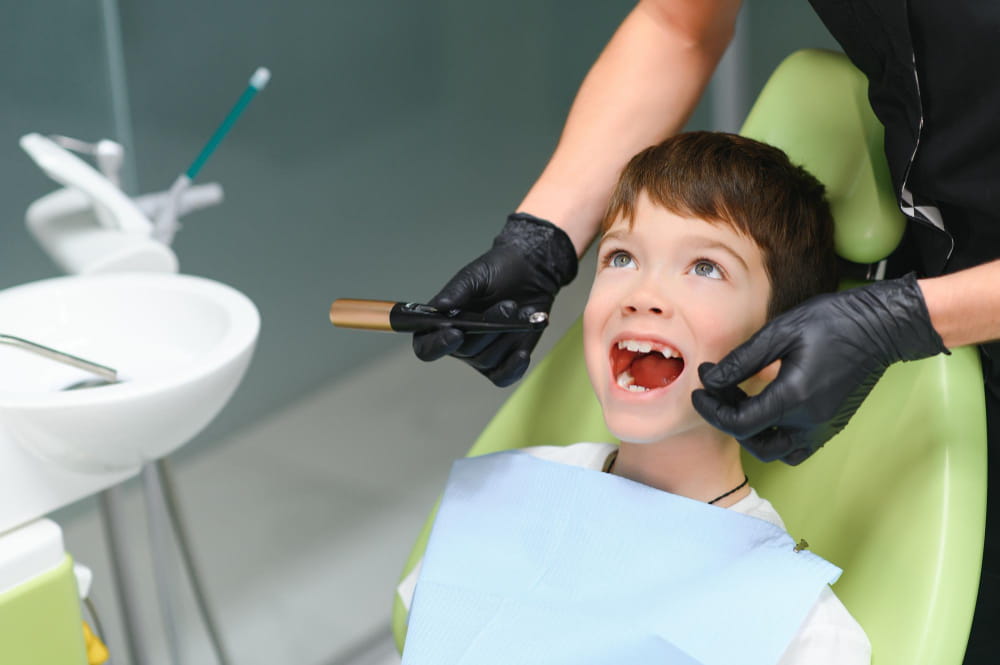
Filling Treatment
Filling treatment is one of the fundamental procedures applied to restore the function and form of teeth that have lost structure due to decay, fracture, wear, or trauma. In pediatric dentistry, a filling is not merely about “closing a cavity”; it is a preventive step that stops the progression of pain, maintains chewing balance, and supports speech and nutrition. This approach is especially important for primary (baby) teeth. Untreated decay in primary teeth can quickly deepen, reach the pulp tissue, and require more extensive procedures.
In children, early filling treatment provides a significant advantage in preserving the vitality of the tooth. Delaying treatment in cases where the enamel layer has thinned, decay has progressed into dentin, or visible cavities have formed can turn a simple filling into a root canal treatment or even extraction. We frequently observe this in clinical practice. Families sometimes say, “There’s no pain yet, let’s wait a bit.” However, decay progression in children can be faster than in adults. The enamel and dentin layers of primary teeth are thinner. Therefore, a cavity that appears small on the outside may be deeper than expected internally.
Filling treatment should not be considered merely an aesthetic correction. A properly done filling in back teeth allows the child to chew evenly on both sides. Fillings in the front region are valuable in terms of aesthetics, speech, and self-confidence. Especially in cases of trauma-related fractures in front teeth, aesthetic restorations can directly affect a child’s social life. For a school-age child, a broken front tooth can sometimes cause more distress than pain.
The treatment plan is shaped according to the tooth’s location, the depth of decay, the material used, and the child’s age. While classic composite fillings may be sufficient for some teeth, glass ionomer-based materials or other restorative options may be considered for certain primary molars or larger losses. Our goal is not just to fill the space, but to restore the tooth to a functional, cleanable, and durable state. The longevity of a filling depends on both the dentist’s application and the child’s oral care habits. Frequent sugar consumption, poor oral hygiene, and irregular check-ups put even the best fillings at risk. Post-treatment care is just as important as the treatment itself.
What Is Filling Treatment?
Filling treatment is the process of cleaning damaged tooth tissue caused by decay or other factors and reconstructing it with a suitable restorative material. In pediatric dentistry, it is one of the most commonly performed procedures to prevent further damage to the tooth. Decay may begin as a small white spot on the tooth surface. If untreated, it progresses through the enamel, reaches the dentin, and eventually forms a cavity. At this stage, the decayed tissue must be removed and the resulting space filled with a biocompatible material. The aim of filling treatment is not just to close the visible hole. If the decayed area is not cleaned, bacteria continue to progress. This can lead to sensitivity, pain, discomfort while eating, bad odor, food impaction, and eventually pulp inflammation. A filling is a restorative procedure that stops the decay process and makes the tooth usable again. When performed early in children, it significantly reduces the need for more extensive treatments. When fillings are recommended for primary teeth, families sometimes ask, “They’ll fall out anyway, is it necessary?” Yes, it is necessary. Primary teeth may be temporary, but their function is not. They are important for proper chewing, clear speech, supporting facial development, and preserving space for permanent teeth. Untreated decay in a primary tooth can become a source of infection and may also affect the development of permanent teeth. The filling material is selected based on the tooth’s location and needs. Composite fillings are often preferred for their aesthetic appearance, especially in front teeth and suitable back teeth. Glass ionomer fillings are valuable in some pediatric cases due to their fluoride release. This fluoride release can help remineralize surrounding tooth tissue. However, material selection is not based solely on aesthetics or a single feature; factors such as the child’s caries risk, isolation conditions, and extent of tissue loss are all considered. Current data show that childhood tooth decay is one of the most common chronic diseases worldwide. In some age groups, the prevalence of decay in primary teeth can exceed 40%, depending on the population. This highlights that although filling treatment may seem simple, it plays a major role in public health. A small cavity detected early can be managed effectively for a long time with proper filling treatment.How Is Filling Treatment Performed?
Filling treatment is carried out in specific clinical stages, and the procedure plan varies depending on the extent of damage. First, it is necessary to determine whether the decay is superficial, moderately deep, or close to the pulp. This is done through an oral examination and, if necessary, X-rays. In children, especially interproximal (between teeth) cavities may appear small externally but be more extensive internally. Therefore, visual inspection alone is not sufficient. Before starting treatment, local anesthesia may be applied depending on the condition of the tooth. Not every filling requires an injection. In superficial cavities, the procedure can sometimes be done without anesthesia. However, if the decay is deep, the child is sensitive, or there is a risk of pain, anesthesia is more appropriate. Once the tooth is numb, decayed tissues are removed using special rotary instruments or, in some cases, hand tools. The aim is not to unnecessarily remove healthy tissue but to eliminate only infected and softened areas. After cleaning the decay, the resulting cavity is evaluated. If a composite filling is to be applied, the tooth surface is prepared with a special acid, followed by the application of a bonding agent. This step is critical for the filling to adhere to the tooth. The filling material is then placed in layers, and each layer is hardened using a special light. This layered technique helps reduce shrinkage stress and ensures controlled placement. Finally, the filling is shaped, adjusted for height, and polished. When different materials such as glass ionomer are used, application steps may vary. These materials can be more tolerant to moisture and may provide fluoride release. They offer certain advantages, especially in children with limited cooperation or high caries risk. However, not every material is suitable for every tooth. The choice depends on durability, aesthetics, application time, and the child’s oral conditions. Ensuring the child’s comfort during the procedure is also an important part of the process. Short breaks, simple explanations, and attention management make a significant difference in pediatric dentistry. You may perform a technically perfect filling, but if the child has a negative experience, future appointments become more difficult. Therefore, treatment is approached as a holistic clinical process, not just material placement. In most cases, the filling procedure is completed in a single session. Simple, single-surface fillings can be finished within 15–20 minutes. In more complex or less cooperative cases, the duration may extend to 30–45 minutes. Aesthetic fillings for front teeth require more careful shaping, while back teeth require proper contact points and chewing anatomy. Incorrect contact can cause food impaction, and improper height can lead to chewing discomfort.Who Is Suitable for Filling Treatment?
Filling treatment is suitable for children who have decay, fractures, wear, or loss of tooth structure, provided the tooth’s vitality can be preserved. The main criterion is that the damage has not caused irreversible harm to the pulp tissue. If the decay is limited to enamel and dentin, there is no severe pain, and the tooth can be restored, filling treatment is a good option. This evaluation is confirmed through clinical and, if necessary, radiographic examination. Both primary and permanent teeth are suitable for filling treatment. Young age is not a barrier; in fact, early detection makes fillings even more critical in preventing larger problems. Especially in children aged 3–8, interproximal decay in primary teeth can be restored effectively if detected early. Delays may lead to the need for pulp treatments. Saying “it sometimes aches but then goes away” does not mean the problem is minor. Children with fractured front teeth due to trauma may also be suitable for fillings. Minor enamel or enamel-dentin fractures and aesthetic losses can be restored with composite materials. However, it is important to assess whether the trauma has affected the root or pulp. In general, suitable cases include:- Decay has not reached the pulp or caused irreversible damage
- The tooth structure can be supported with restoration
- The child can show basic cooperation during the procedure
- No widespread infection, abscess, or severe pain is present
- The fracture or loss can be functionally corrected with a filling
Precautions Before Filling Treatment
Precautions before filling treatment help ensure a comfortable procedure and a positive clinical experience. The child should not arrive overly hungry or overly full. A light, balanced meal is ideal. Families should provide complete medical information, including medications, allergies, and health conditions. Communication is also important. Instead of saying “don’t be afraid, it won’t hurt,” it is better to use simple and honest explanations like “the dentist will clean and fix your tooth.” Key points before the appointment:- The child should have a light meal
- Medical history should be shared completely
- Avoid frightening language
- Do not give medication without dentist advice
- Schedule at a time when the child is well-rested
- Brush teeth before the visit
Precautions After Filling Treatment
After treatment, if local anesthesia was used, numbness may last 2–4 hours. During this time, children should avoid biting their lips, cheeks, or tongue. Hot foods should be avoided initially. Mild sensitivity may occur for 24–48 hours, especially with deep fillings. If pain increases or persists, reevaluation is needed. Hard and sticky foods should be limited for a few days. Key points after treatment:- Monitor for biting injuries until numbness wears off
- Avoid hot foods initially
- Limit hard and sticky foods briefly
- Mild sensitivity is normal; increasing pain requires check-up
- Maintain regular brushing
- Do not delay follow-up appointments
When Is Filling Treatment Applied?
Filling treatment is used in many cases involving tooth structure loss, most commonly due to decay. It is also applied in fractures, developmental defects, and aesthetic corrections. Common indications include:- Small to moderate decay-related tissue loss
- Enamel and dentin fractures
- Interproximal cavities
- Developmental enamel defects
- Aesthetic front tooth damage
- Food impaction areas
How Long Does Filling Treatment Take?
The duration depends on the extent of the procedure:- Small, single-surface filling: 15–20 minutes
- Medium, two-surface filling: 20–30 minutes
- Deep or multi-surface filling: 30–40 minutes
- Aesthetic front tooth restorations: 20–35 minutes
- Less cooperative children: 40+ minutes
Filling Treatment Prices
Prices vary depending on the type of restoration, tooth location, extent of decay, and materials used. Composite fillings are often preferred for aesthetics, while glass ionomer materials may be chosen for their fluoride release. Factors affecting cost:- Primary vs. permanent tooth
- Front vs. back tooth
- Number of surfaces involved
- Type of material used
- Depth of decay
- Need for X-rays and follow-ups
- Clinic location and equipment
My Happy Patients
Patient Reviews
5 yaşındaki oğlumun diş tedavisi için çok endişeliydim ama doktorumuz sayesinde her şey beklediğimden çok daha güzel geçti. Sedasyonla hiçbir şey hissetmeden, korkmadan tedavisini oldu. Çocuğuma yaklaşımı, sakinliği ve güler yüzü bizi çok rahatlattı. Hem oğluma hem bize güven verdiğiniz için size çok teşekkür ederiz, iyi ki yollarımız kesişmiş.
M.K.
Лучший русскоязычный детский стоматолог в Анталье! Очень деликатный и профессиональный подход к маленьким деткам. После приема все дети уходят действительно довольные и очень счастливые. Огромное спасибо нашему дорогому доктору за такую добросовестную работу и искреннюю любовь к своим маленьким пациентам! 🌸🌸🌸
I.P.
Мои дети совсем не боятся ходить к стоматологу, потому что у нас есть замечательный врач Раиса. Мы точно знаем, что нам всегда будет оказана самая квалифицированная помощь. Кроме того, Раиса умеет находить подход к детям, она очень спокойная, чуткая и добрая. Мы очень любим нашего стоматолога и всегда доверяем только ей.
❤️
A.P.
Kızım 8 yaşında ve asla bir diş hekimine götüremiyorduk.
Çok korkuyordum nasıl oturtacağız o koltuğa?!
Raisa hanımın yaklaşımı ve kızımla uyum sağlamasına inanamadım. Asla huysuzluk yapmadan oturdu o koltuğa.
Çok çok teşekkürler Doktor hanım❤️Emeğiniz ilginiz alakanız için çok teşekkür ederiz
D.A.
Выражаем наше большое спасибо доктору за невероятную заботу и очень внимательное отношение к нам! Лечение зубов под седацией прошло на удивление спокойно, и наш ребёнок совсем не боялся процесса. Мы очень сильно благодарны вам за ваш высокий профессионализм, доброту и чуткость. Вы настоящий мастер своего дела, который умеет найти
Д.я.
У сына разболелся зуб. Обратилась к доктору Раисе в Коньялты. После лечения захотелось написать отзыв. Ребёнку шесть лет, он очень боится врачей, но здесь страх сразу исчез. Всего были в клинике три раза, лечили каналы. Доктор всё показала и доходчиво объяснила. Она очень внимательная и чуткая. Нам повезло!
Л.Б.
Oğlumu 9 yaşında dişlerini kolay kolay bakıtmaz yaptırmaz diş hekimlerinden korkar ve özel eğitimli bir çoçuk bir kaç doktor gezdik asla bakıtmadı RAİSA HANIM tanıştıktan sonra korkularımız azaldı
diş amaliyat Raisa hanım yaptı
Başta diş hekimi Raisa hanıma sonra ekibine çok teşekkür ederim ☺️ 🙏 Tedavi olmak isteyen herkese tavise ederim
N.Y.
Это был первый визит моего ребёнка к стоматологу. Мы были на отдыхе и очень переживали, но доктор Раиса Ахмадова оказалась просто волшебником! Она спокойно объяснила процесс, шутила и вовлекла ребёнка. Всё прошло настолько легко и позитивно, что ребёнок полностью расслабился. Огромное спасибо за ваше внимательное о
I.A.
Kızımın diş tedavisi için düzenli olarak Dr. Raisa Ahmedova'ya gidiyoruz ve her seferinde inanılmaz memnun kalıyoruz. Kendisi hem çok profesyonel hem de çocuklarla inanılmaz ilgili ve sabırlı. Kızım dişçi koltuğuna oturmaktan çekiniyordu ama Raisa hanımın sıcak yaklaşımı sayesinde hiç korkmadan tedavisini tamamladı. İşini büyük bir özenle ve titizlikle yapıyor.
R.G.
Çocuk ruhuna hitap eden, muhteşem bir diş hekimi.Başka bir klinikte ağlayarak koltuğa oturduğu için hemen ameliyatli tedaviye yönlendirilen oğlum Raisa hanım sayesinde gayet sakin bir şekilde dolgusunu yaptırdı.Asistani da oğluma destek oldu, ekip olarak muhteşemler .... Birçok dişi tedavi edilmesi gereken oğlum "anne ben tekrar gelirim bu doktora " dedi.
N.Ç.
Oğlumun diş ağrısı vardı. Fotoğrafta Türkçe adı yazılı olan klinikte Dr. Raisa'ya gittim (Türkçe bilmiyorum :)). Konyaaltı bölgesinde. Tedaviden sonra bir yorum yazmak istedim. Anlarsınız, 6 yaşında bir çocuk doktorlardan korkar. Ama ilk ziyaretten sonra artık korkmuyordu. Toplamda üç kez kliniğe gittik. Dişi kurtarmak için kanal tedavisi yaptılar. Herşey için teşekkürler
H.İ
Contact Us!
We’re here to help with all your questions and requests.
-
Toros Mah. 805 Sk. Kurgu 1 Plaza No: 14/1 KONYAALTI/ANTALYA